OCSP Funds in Action: Community Care Concepts of Woolwich, Wellesley and Wilmot

How one CSS organization used OCSP funding to safeguard hospitals throughout the COVID-19 crisis.

January 24, 2022

While taking preventative actions to safeguard our healthcare system may have been a new concept for the general public, brought to light by COVID-19, it has long been a driving force for Community Support Sector (CSS) organizations.
 
Such is the case for Community Care Concepts of Woolwich, Wellesley and Wilmot, the only CSS provider across three townships and rural Waterloo Region. “We are the go-to organization for supporting seniors, or what we would call ‘adults with unique needs’ to live in their homes,” Executive Director Cathy Harrington explains.  
 
These supports include home care services like light housekeeping or home maintenance assistance, nutrition programs like Meals on Wheels, transportation services to help seniors and adults with disabilities attend their medical appointments, and respite and adult day programs, which afford family caregivers essential rest and support.
 
Cathy explains that, without services like the ones they offer, vulnerable individuals would struggle, putting physical and financial pressure on other parts of the healthcare system. “They would be contacting their physician, if they had one, they'd be showing up in Emerge. Their needs would be escalating to a certain point that they would become much more in a state of crisis.”
 
But individuals in need don’t always approach organizations like Community Care Concepts of Woolwich, Wellesley and Wilmot for help. Sometimes, they don’t know help is available, or worry that it will come at a cost. “Many people fear that someone will assess them, and decide that they can't stay in their own home,” Cathy says. The reality is, CSS organizations will not remove folks from their homes– in fact, their aim is to do the exact opposite. Helping people age at home – and keeping them out of hospitals and long-term care – is exactly what the community care sector excels at. 
 
With a catchment area spanning a large, rural geography, and an aging population, where “two of the three townships that we serve have a higher percentage of older adults than in the rest of the region,” connecting their services with the people who need them the most can be challenging for Community Care Concepts of Woolwich, Wellesley and Wilmot.
 
To help, they’ve developed a network of community partnerships to connect with potential clients as efficiently as possible—a system that prepared them well for the past couple of years. “The pandemic really shone a spotlight on our need to work together,” Cathy says, “For us, it's trying to figure out…what other services [folks are] already engaged with, and how we can work with those other providers to complement the work that they're doing.”
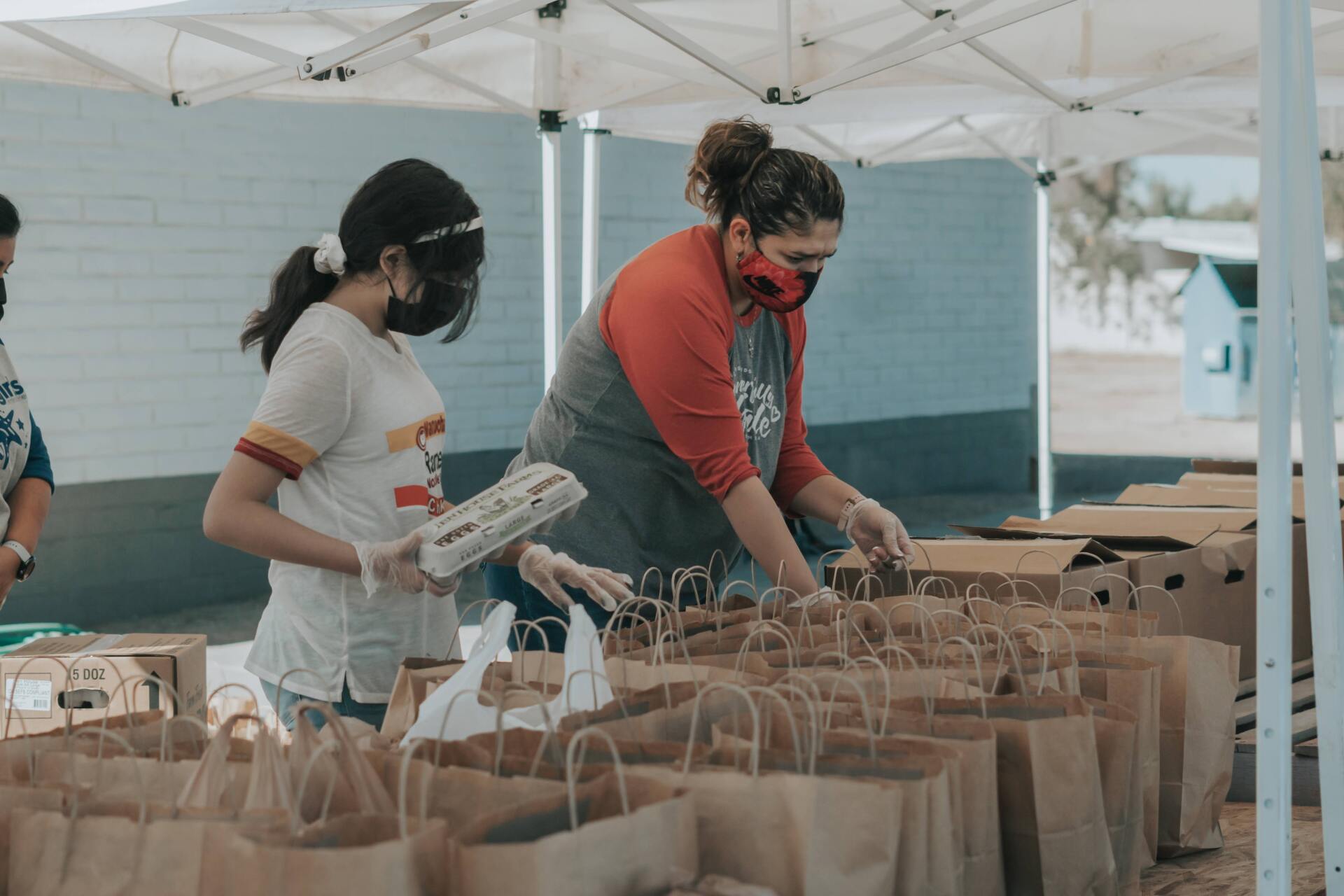
A bunch of red and green bags filled with food

One opportunity to do this came through long-standing partnerships with the local police and bylaw officers. “Working with the Waterloo Regional Police Services and our local Community Resource Officer, we provided care packages that could be distributed as they were dispatched to calls and vulnerable residents were identified,” Cathy says. “With support of OCSP funding, the Community Resource Officer identified an elderly client who did not have access to food. The care package provided immediate support until the individual could be linked to subsidized meals through Meals on Wheels and additional supports.”


Another form of outreach this year was working with a local group called Stuffin Stockings. By helping to deliver stockings of donated goods to vulnerable individuals, Community Care Concepts of Woolwich, Wellesley and Wilmot was able to connect with close to 300 people who could potentially use their services.

While reaching and helping people who need it is always a win for Community Care Concepts, the risk that a growing number of people may become reliant on their services comes with a new set of challenges. “I think that the challenge for us is, what happens after the end of [the Ontario Community Support] program? Because we have attracted far more individuals than we would have been serving before, [who] all have very real needs. And those needs will not go away when the funding [ends],” Cathy says. “How do we sustain that?”


Although Ontario’s strong Home and Community Support Sector is vital for a sustainable health system, precarious funding puts the future of programs like these in serious jeopardy – and puts the entire health system at risk. “We were so thankful to have the Ontario Community Support Program, because it gave us additional flexibility, to be able to truly respond to those needs that were out there,” Cathy says. “But…the needs continue to climb. And long after the program is over, we'll have to continue to figure out as an organization how we respond to those needs.”


While the future may be uncertain, Community Care Concepts of Woolwich, Wellesley and Wilmot, like so many CSS organizations, is leaning on its strengths to find the way forward: resilience, productive partnerships, and a strong sense of what vulnerable people need locally, on the ground.

Share

More Updates

By Karla Sealy • September 24, 2026
September, 2026 - Meals on Wheels Ontario is excited to partner with the LCBO on a province-wide fundraising campaign to support food security for seniors and people with disabilities across Ontario. Customers can purchase a reusable LCBO and Meals on Wheels tote bag, designed by Ontario artist Sarah Farquhar, at participating LCBO stores and online . 100% of proceeds from the tote bag campaign will be donated to Meals on Wheels Ontario to provide meals to seniors and people with disabilities. Funds raised through the campaign will help support clients experiencing financial hardship and help reduce barriers to accessing nutritious meals. Looking for a tote bag? Find a participating LCBO store near you. You can also purchase a tote bag online through LCBO. Share your support Picked up a tote bag? We’d love to see it! Share a photo of your tote bag on social media and tag Ontario Community Support Association so we can see and share your campaign moments. See more at MOW and LCBO Tote Campaign | Meals on Wheels | ON
By Karla Sealy • June 30, 2026
Toronto, ON – June 30, 2026 – Nearly 700 Ontarians are currently waiting in hospital for home care or community support services to be arranged before they can safely return home, according to data available from Ontario Health. The Ontario Community Support Association (OCSA) says the figures demonstrate the growing urgency of investing in the services that make aging at home possible. These findings come as new data from the Canadian Institute for Health Information (CIHI) highlight ongoing emergency department pressures across Canada and as more than 45,000 Ontarians remain on long-term care waitlists in the community. Together, these numbers point to a fundamental shift occurring across Ontario's healthcare system: more people are living longer at home, often with increasingly complex needs, while demand for community-based care continues to outpace available capacity. "Ontario has entered a new era of healthcare," said Lori Holloway, Chief Executive Officer of OCSA. "For years we've talked about aging at home as a goal. Today, it is the reality. More than 45,000 people are waiting for long-term care in the community, and nearly 700 patients are waiting in hospital for the home care and community support services needed to return home safely. The question is no longer whether Ontario needs more community capacity. The question is how quickly we can build it." Ontario's not-for-profit home care and community support organizations provide the services that make aging at home possible, including home care, transportation, Meals on Wheels, assisted living, caregiver supports, adult day programs, wellness services and hospital-to-home programs. Without these supports, seniors are more likely to remain in hospital longer, experience avoidable health crises, or require earlier admission to long-term care. “Community care is increasingly becoming healthcare's pressure valve," said Holloway. "Every hospital bed occupied by someone waiting for community services tells us the same thing: the demand for aging-at-home supports is growing faster than the system's ability to provide them. If we want to improve hospital flow, reduce pressure on emergency departments and help people remain independent longer, we need to accelerate investment in community capacity." OCSA is calling for continued investments in home care, community support services, caregiver supports; not just service volume increases but the necessary infrastructure funding to ensure Ontario can meet the needs of a rapidly aging population. "Ontario has made important investments across hospitals, long-term care and home care," Holloway added. "The next phase of healthcare transformation must focus on building the aging-at-home capacity that will determine whether our health system can meet future demand." For more information: Karla Sealy Manager, Advocacy, Policy and Community Engagement karla.sealy@ocsa.on.ca 416-256-3010/1-800-267-6272, ext. 242
By Karla Sealy • May 6, 2026
Ontario's health system is at a crossroads. Nearly one in five Ontarians is over age 65, more than 2.5 million people are without access to primary care, and hospitals face persistent Alternate Level of Care (ALC) pressures. Meanwhile, long-term care (LTC) waitlists exceed 48,000 people and are projected to grow. The most cost-effective and compassionate solution is to invest in a comprehensive suite of services including community support services, home care and independent living services, which allows people to remain in their homes and communities while reducing system pressures.
More Posts